[consulting_grind]
- Apr 6
- 8 min read
Updated: May 9
The Grind: What 2+ Years of Consulting Taught Me
Most people think about career moves in terms of titles and salaries. I prefer to think about them in terms of optionality (i.e. what doors could they open). Consulting enabled me to grow my career faster than any traditional corporate path could have - but there was a real, tangible cost.
The consulting chapter of my career wasn't simply a stepping-stone. It was a complete shift on how I thought about career growth and progression. Reframing this period from sacrifice to strategy is the thing most people miss when assessing such opportunities.
For more than two years, I flew roundtrip, Calgary to San Francisco, every week. During this time, I was forced to operate outside of my comfort zone, work 60+ hour work weeks, and forged relationships that ultimately blossomed into employment opportunities. This was one of the most memorable and informative periods of my entire career - I look back this time fondly, and part of me misses the pace, lifestyle, and people. The grind was real, but fulfilling.
Most folks are surprised that someone would voluntarily shift from a cushy oil-and-gas corporate gig to such a demanding, unpredictable job, but the results paid handsomely.
2+
years of weekly flights to/from the Bay Area
60+
hour work weeks, consistently
3x+
total comp opportunity landed
SECTION 01
Why Consulting Accelerates Career Growth: The Structural Argument
Let's be clear - consulting isn't for everyone, nor will everyone realize the same benefits from pursing a career in this field. However, if you're a go-getter, a grinder, someone that's highly ambitious, good with people, and a natural problem solver, consulting will accelerate your career much faster than the traditional corporate path. It's a direct result of experience compression, level compression (sink or swim), and a performance-oriented culture - let's take a look.
Experience Compression - in a conventional role, you're limited to one organization, one set of problems, one leadership team. Depth develops, but breadth struggles. In consulting, it's the opposite - many organizations, many cultures, many classes of problems, and many leadership teams - all in rapid succession. Each client engagement acts like a concentrated development cycle. Exposure that would normally take several years to accumulate can happen in months.
Level Compression - in most organizations, your defined 'seniority' or 'title' determines the problems you're tasked with solving and stakeholders you interact with. Consulting doesn't follow this. A few months into my consulting career, I was presenting to clients, pitching to executives, navigating a morass of organizational politics, and being held accountable for deliverables and outcomes that were well outside of my comfort zone. That exposure calibrates you differently - you either rise to the occasion, or fall to mediocrity. Being forced to operate at a level well above your experience and title is exactly what accelerates career growth.
Performance Culture - consulting firms operate on a model that blends extreme professional rigor and a marathon-paced intensity, often defined by an "up or out" mentality. You're expected to continuously evolve your skills and take on ever-increasing complexity and scope (they often quoted "if you're not growing, you're dying"). You don't just 'own a deliverable', you 'own an outcome'. The bar for hiring is often incredibly high, and as a result, you're surrounded by top-talent - this forces you to 'level up', but presents great networking opportunities (I have many fond memories of working side-by-side in the Calgary 'bull pen').
KEY TAKEAWAYS
1) Consulting compresses development - multiple organizations, problems, and stakeholder groups in quick succession
2) Exposure to senior leadership recalibrates your operating level in a permanent way
3) The performance culture sets a baseline work expectation that conventional roles rarely match - and this 'new baseline' becomes your competitive advantage
4) Consulting is faster, not necessarily better - it's the right choice for highly-motivated individuals with a knack for solving problems and embrace
SECTION 02
The Weekly Commute: The Cost
For over two years, my weekly schedule looked like this - Monday alarm at 4:00 a.m. followed by travel to the airport and a commute from Calgary to San Francisco (pray for direct flights and no delays); Monday afternoon through Thursday spent at the client site, often slugging through 12+ hour days; Thursday evening commute back to Calgary; Friday travel to the local consulting office for the 'anchor day' (i.e., mandatory attendance for firm building activities and socializing); Saturday and Sunday personal time, packing, and recovery (never quite sufficient). Rinse and repeat. For kicks, I asked Gen AI to re-create my weekly schedule - this helps to illustrate the insanity.
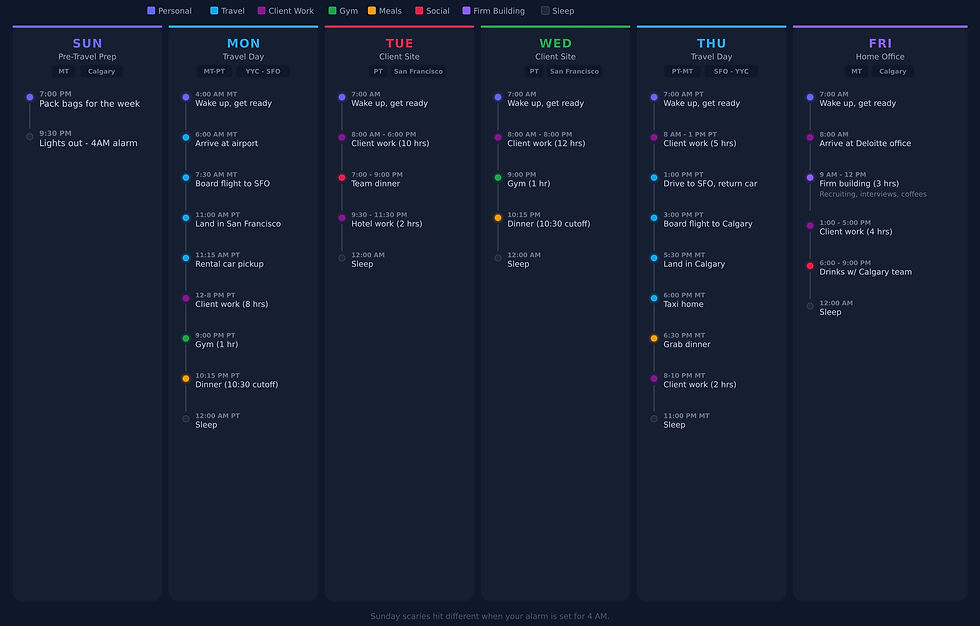
The personal cost of this schedule was immense. Personal relationships were strained, my social life muted, and I was often absent from many important family gatherings. My hobbies were little-to-none (outside of weight lifting), and typical routines were fragmented and compressed.
What kept me going wasn't blind ambition or an inability to recognize the cost. It was a burning belief that the grind would pay off. The calculation was deliberate - short term sacrifice, for a set period of time, would create options that a more comfortable path simply wouldn't. I had an objective and conviction - this is fundamentally different than grinding without a goal in mind.
The schedule and pace also signaled something - to the client, to the organization, to the people who were evaluating my performance. Every week I showed up, delivered above expectations, and continued to foster strong relationships. This type of personal behavior or 'brand' can't be gleaned from a resume or a performance review, it's earned through doing the work.
KEY TAKEAWAYS
1)The grind becomes easier when you have a defined objective and a finite horizon - indiscriminate intensity without a purpose is a dangerous path that often leads to burnout
2) Difficult is a selection mechanism - the people who are able to persevere are the ones who earn professional credibility
3) Be honest with yourself about the personal cost before you commit, not after - it affects everyone in your life
SECTION 03
The Client-to-Employer Pipeline: My Exit Op
After two years of non-stop grinding, I was starting to burn out. I was looking for my exit-opportunity (exit-op). I was already in the process of transferring to the US-arm of the consulting firm I worked for (a story for another time), but the client offer materialized first...and I'm incredibly thankfully that it did!
What I discovered during my time consulting is that your client engagements often become your most credible career opportunities - a potential direct conversion path that's almost impossible to recreate through conventional job hunting. The client-to-employer jump isn't stated explicitly, and frankly is often discouraged or blocked due to contractual language, but having the courage to fight through this is worth it.
The logic makes sense. Companies hiring from the outside market are blind, they're making a bet on incomplete information - a resume, a few rounds of interviews, and possibly some biased references. The uncertainty is high and the cost of a wrong hire is significant. However, when a company hires a consultant with a proven track record, it's almost a guaranteed fit.
In my case, I built and fostered relationships over the two-plus years of my client engagement, relationships that extended well beyond my formal project scope - social outings, dinners, events, etc. When my client had an opportunity to hire a new team member, they already had a name in mind - me. The conversation that followed wasn't cold and awkward, it was simply a continuation of the existing relationship - a win-win for both parties. The offer was finalized over a coffee and a handshake.
Stop treating every client engagement as simply a project to be delivered and start treating it as an audition for a potential position. Take ownership as if you were already an employee and manage expectations accordingly - underpromise, and overdeliver (one of my favorite quotes from my time as a Geek Squad member at Best Buy).
KEY TAKEAWAYS
1) Your best clients are your highest-conviction career opportunities - you already have a demonstrated track record
2) A substantial consulting relationship that converts to employment eliminates almost all hiring uncertainty
3) Treat high-value client engagement as long term auditions; deliver above expectations and with a long-term perspective, not simply as a consultant
4) Build relationships beyond your formal project scope - the people who advocate for your conversion are putting their reputation on the line
5) Be selective - this is only worth pursuing where there is strong synergy across the client organization, market, and job opportunity
SECTION 04
The Financial Outcome: What the Grind Was Actually Worth
Switching from a consultant to a full-time San Jose employee in 2018 tripled my compensation on a currency adjusted basis. Not an incremental raise. Not thirty percent. Three hundred percent, which has subsequently grown much higher. That single transition compressed a decade+ of traditional wage growth into a single event.
[2016] - New Zealand: traveled to support a client implementation that lasted twelve weeks, an incredibly rewarding and fulfilling experience
[2016-2018] - Calgary: consultant, weekly travel, 60+ hour weeks, establishing the foundation and trajectory
[2018] - San Jose: relocated to the US. Total compensation tripled (on a currency-adjusted basis), two years of investment finally pays off.
[2018-2022] - San Jose: multiple promotions with significant total comp increases, the flywheel accelerates
[Late 2022] - Washington State: strategic re-location from California eliminates state income tax and reduces cost of living - significantly increasing my savings rate
[2025-2026]: financial independence (FI) achieved
The emphasis isn't on the numbers - it's the direct connection between the career decisions and the outcomes. Most folks would probably call this path unsustainable, but unsustainability was exactly the point - short term sacrifice for long-term gain - it was a finite investment with an expected return.
KEY TAKEAWAYS
1) Career decisions are financial decisions - the consulting-to-tech employment conversion compressed a decade+ of income progression into a single event
2) A 3x compensation jump on day one of a US role is not unusual for senior Canadian professionals - the gap is structural
3) The financial return on two years of intensive consulting investment was compounding: higher base -> larger bonuses -> equity grants -> promotion opportunities -> larger bonuses -> larger equity refreshes
4) Think of career intensity in finite terms, a specific level of investment, for a defined period, for a specific return. Harvest season only comes once per year.
SECTION 05
Who This Path Is (And Isn't) For
Consulting isn't for everyone, but it should be a strong consideration for folks that are highly ambitious, thrive in high-autonomy environments, have a knack for solving problems, and are okay with the requisite travel (although this has likely changed since COVID). The intensity of 60+ hour consulting weeks and weekly travel is not a challenged to be endured (you'll burn out), but rather an environment and lifestyle to be embraced.
For people who are early in their careers and considering whether to enter consulting at all, my honest take is to simply try it - you have little to lose. Two to four years of operating in a consulting environment will develop you faster than almost any alternative. The compressed exposure, the stakeholder facetime, and the performance culture shape you into a corporate weapon.
KEY TAKEAWAYS
1) This path requires a genuine fit, not just willingness - consulting needs to become your identity for you to truly succeed
2) Define your exit horizon (and potential exit ops) before you start - the grind is more sustainable when it has an end date
3) For early-career professionals with high ambition and low external obligations, two to four years in consulting creates one of the best professional foundations
4) Be honest about the personal toll
The Mentality Underpinning Everything
Two years of weekly flights built grit and character. It reinforced a real set of operating instincts that are still with me today - always show up, overdeliver, underpromise, and treat every personal and professional engagement as if your individual brand depends on it, because it does.
My consulting chapter was the most formative period of my career, full stop. It wasn't comfortable, but the payoff was worth it (the subsequent job opportunity enabled me to achieve accelerated FI). For someone trying to bridge the gap between where they are and where they want to be - professionally, geographically, and financially - I can't recommend consulting enough. If you're willing to put in the time and effort, it's one of the most reliable paths to career acceleration and new opportunities.
Keep grinding.
MAK
![[freedom_35]](https://static.wixstatic.com/media/d883d3_dd587db7471f4351a564a51ee3993ec8~mv2.jpeg/v1/fill/w_658,h_360,al_c,q_80,enc_avif,quality_auto/d883d3_dd587db7471f4351a564a51ee3993ec8~mv2.jpeg)
![[calculating_fi]](https://static.wixstatic.com/media/d883d3_dff6381132e642c59480f4874b4a5bee~mv2.jpg/v1/fill/w_980,h_513,al_c,q_85,usm_0.66_1.00_0.01,enc_avif,quality_auto/d883d3_dff6381132e642c59480f4874b4a5bee~mv2.jpg)
![[investing_framework]](https://static.wixstatic.com/media/d883d3_fdf685d9a0bc4b548eb6d54ff339c3b1~mv2.jpg/v1/fill/w_670,h_670,al_c,q_85,enc_avif,quality_auto/d883d3_fdf685d9a0bc4b548eb6d54ff339c3b1~mv2.jpg)